
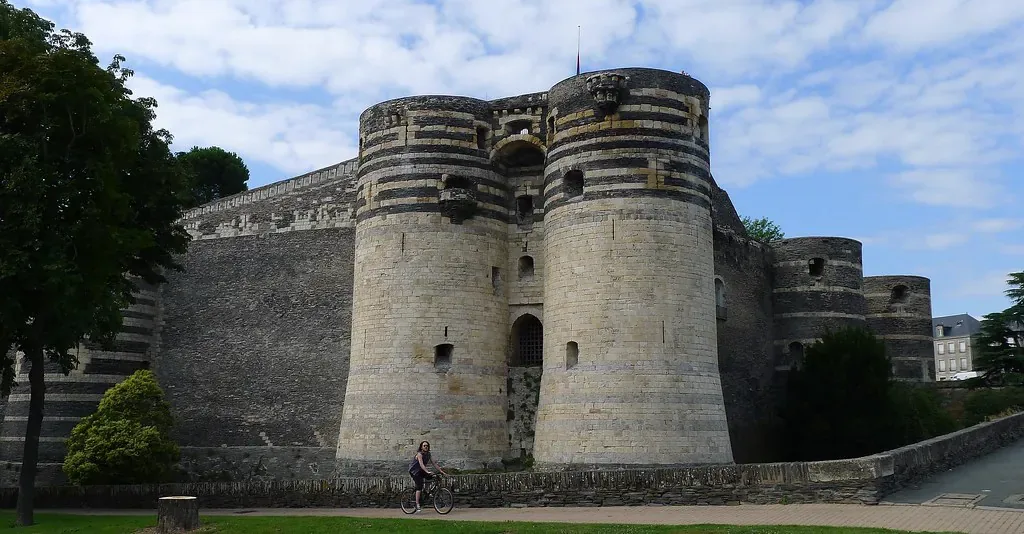
White limestone elegance defines central Touraine, yet step off the TGV in Angers and the stonework turns dark, heavy, and unapologetically military. Seventeen massive semicircular towers striped in black slate schist and pale tuffeau limestone loom straight over the Maine River. Built during the 13th century under Regent Blanche of Castile and young King Louis IX, Château d’Angers never pretended to be a country pleasure house.
It was a border lock guarding Anjou against Brittany and Plantagenet rivals. Inside those austere walls, though, sits one of Europe’s greatest medieval artistic survivals alongside calm courtyard gardens and a terraced hillside vineyard.
Essential Logistics & Takeaways
- CMN Seasonal Rates (No Non-EEA Surcharge): Adult entry costs €14.00 (~$15.10) in High Season (May 2 to September 4) and €11.00 (~$11.90) in Low Season (September 5 to April 30).
- Joint Pass Option: Pair Angers with Château d’Azay-le-Rideau on a single CMN joint ticket for €24.00 (~$25.90) High Season or €20.00 (~$21.60) Low Season.
- Free Entry Days & Youth Rules: Free for everyone under 18, 18-25 EEA nationals or long-term residents, disabled visitors plus one companion, and all visitors on the first Sunday of November through March.
- Fast TGV Access: 1 hour 21 minutes to 1 hour 35 minutes from Paris Montparnasse to Angers Saint-Laud, followed by an 8- to 10-minute walk to the main gate.
Seventeen Schist Towers Over the Maine River
Walk along Promenade du Bout du Monde before crossing the drawbridge. You immediately notice why photographers spot Château d’Angers across town: horizontal bands of local black schist alternate cleanly with pale tuffeau courses, creating a striped drum effect across 17 semicircular defensive towers. Originally crowned by steep conical roofs, later truncated in the 16th century during religious wars so cannons could sit atop the masonry, the outer ring still feels impregnable.
Climb up onto the ramparts walk for broad views across Angers’s slate rooftops, Saint-Maurice Cathedral spires, and the Maine River winding south toward its confluence with the Loire. Keep your balance near narrow crenellations if wind gusts pick up off the river valley. Down in the dry moat below the bridge, formal boxwood beds and quiet lawns soften the sheer drop of the curtain walls, a reminder that defensive ditches here haven’t seen siege water in centuries.
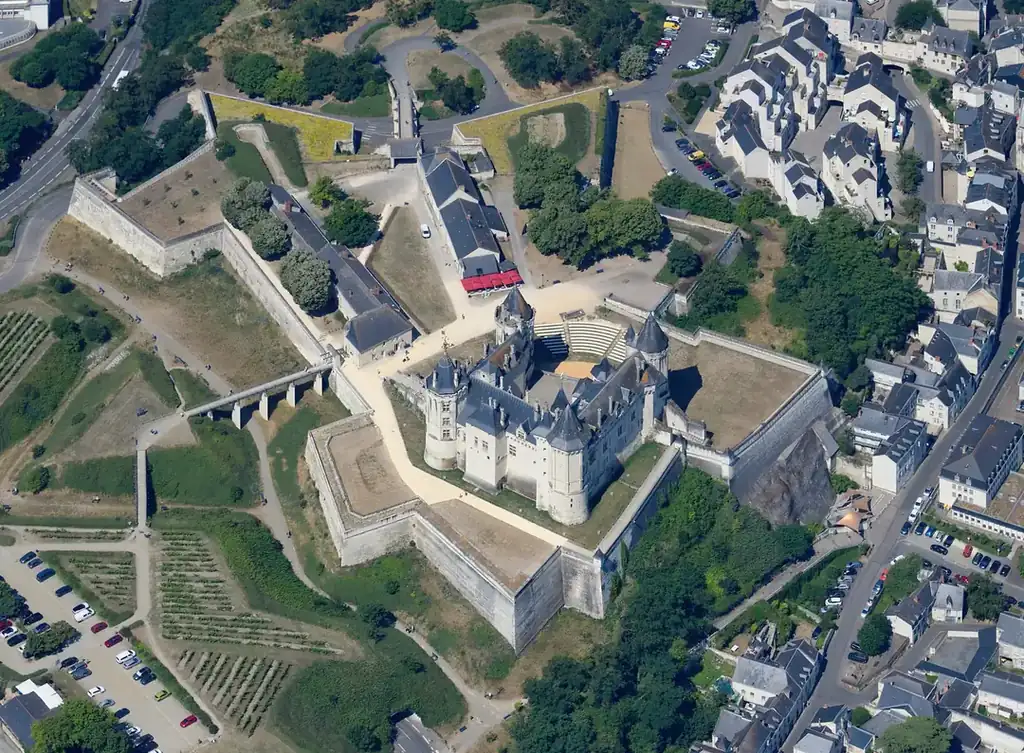
Blanche of Castile and young Louis IX raised this monumental fortress circuit in the 1230s specifically to tighten royal control over western France. Once inside the upper bailey, pause by the Gothic royal lodgings (Logis Royal), the Chapel, and the Governor’s Residence (Châtelet). There, 14th- and 15th-century dukes of Anjou softened a grim military citadel with bright residential chambers and terraced courtyard gardens. Budget 2 to 2.5 hours overall. That gives you time to tour the perimeter walls, inner buildings, and woven gallery without sprinting.
Inside the Apocalypse Woven Cycle (Tenture de l’Apocalypse) Gallery
Cross the inner courtyard past the Gothic royal lodgings, the chapel, and a small terraced vineyard, then step down into the hushed, low-lit gallery built specifically to protect the Apocalypse Woven Cycle (Tenture de l’Apocalypse) (Tenture de l’Apocalypse). Commissioned around 1373 to 1382 by Louis I of Anjou and woven from cartoons drawn by Hennequin de Bruges, this monumental work depicts the Book of Revelation in vivid wool reds, deep indigos, and gold-toned yellows.
More than 100 meters of original woven panels survive today, making it the largest and oldest surviving medieval woven hanging cycle in the world. Not every panel remains intact after centuries of revolutionary neglect (segments were famously cut up in the 18th century to protect orange trees from frost before being rescued and stitched back together in the 19th century). What remains still stops people in their tracks. Look closely at the fine weaving along the borders: unlike delicate Renaissance silk hangings, both front and back faces look nearly identical in crispness.
Allow at least 45 to 60 minutes inside this single gallery alone. Lighting stays deliberately dim to shield the medieval dyes from fading, and folding gallery stools sit along the route if you want to rest while taking in individual scenes.
Admission Prices, Joint CMN Pass & Free Sundays
Château d’Angers is managed by the Centre des monuments nationaux (CMN), whose seasonal pricing applies uniformly to all adult visitors regardless of passport nationality. Check official timetables and pre-book slots through the official Château d’Angers portal or the national Centre des monuments nationaux website.
| Season / Ticket Type | Adult Rate | Group / Reseller Rate | Free Eligibility |
|---|---|---|---|
| High Season (May 2, Sep 4) | €14.00 (~$15.10) | €11.50 (~$12.40) | Under 18 (all); 18-25 EEA only |
| Low Season (Sep 5, Apr 30) | €11.00 (~$11.90) | €9.50 (~$10.25) | Under 18 (all); 18-25 EEA only |
| Joint CMN: Angers + Azay-le-Rideau | €24.00 (~$25.90) High / €20.00 (~$21.60) Low | , | Same CMN exemptions |
Hold on, does that joint CMN ticket actually make sense? Run the math first. Standard adult admission totals €30.00 (~$32.40) in summer (€14.00 (~$15.10) at Angers plus €16.00 (~$17.30) at Château d’Azay-le-Rideau) or €24.00 (~$25.90) in winter (€11.00 (~$11.90) plus €13.00 (~$14.05)). Buying the joint pass saves €6.00 (~$6.50) in high season and €4.00 (~$4.30) in low season if you plan to tour both western Loire estates.
Everyone, regardless of nationality, enters free on the first Sunday of November, December, January, February, and March, plus during European Heritage Days on the third weekend of September. Visitors with disabilities plus one companion, EU/EEA job seekers, children under 18 of any nationality, and 18-25-year-old EEA nationals or long-term EEA residents also qualify for free admission with valid documentation.
Opening Hours, Accessibility Split & Urban Parking
Gates open daily from 10:00 AM to 6:30 PM during High Season (May 2 to September 4) and 10:00 AM to 5:30 PM during Low Season (September 5 to April 30). Closing shifts earlier to 4:30 PM on December 24 and December 31, while the monument closes completely on January 1, May 1, and December 25. Remember the 45-minute cutoff: last entry closes 45 minutes before posted closing time.
Accessibility here splits sharply between ground attractions and fortified heights:
- Accessible by Ramp & Lift: A paved entrance ramp and an interior platform lift connect the Apocalypse Woven Cycle (Tenture de l’Apocalypse) Gallery, the Governor’s Residence, and the Chapel for wheelchair users. Two loaner wheelchairs and folding gallery stools are available on-site.
- Inaccessible Zones: The perimeter ramparts and the Mill Tower involve steep medieval stone flights and narrow landings that cannot accommodate wheelchairs or strollers.
Drivers don’t get a dedicated castle lot here, because the fortress sits right inside Angers’s historic center. Visitors with reduced mobility can call at the entrance gate intercom for drop-off access; general drivers use nearby municipal garages at Place Kennedy or Parking du Château on Rue de Quatrebarbes. Note that Angers metered street spaces grant free parking up to 12 hours to holders of an official EU Disability Parking Card paired with a blue parking disc. If you are driving straight from Paris or Tours, check parking signs carefully around the old city streets so you do not wander into restricted pedestrian zones near the cathedral quarter.
Traps, Restrictions & Tourist Realities
- Non-EEA 18-25 Exclusion: Although adult tickets carry zero nationality surcharge at Angers, the free 18-25 youth exemption strictly excludes non-EEA tourists (US, UK, Canadian, Australian visitors aged 18-25 pay full adult fare).
- May 1 Closure: Unlike Cheverny or Chenonceau, CMN-managed Château d’Angers closes on May 1 (French Labor Day) alongside January 1 and December 25.
- No Strollers or Wheelchairs on Ramparts: Plan your visit around the accessible courtyard, chapel, and woven gallery if anyone in your party cannot climb stone steps, because rampart walkways stay off-limits to wheeled mobility aids.
- 45-Minute Last-Entry Gate Lock: Arriving at 4:50 PM in winter means turned away at the ticket barrier, even though closing is posted as 5:30 PM.
Reaching Angers by TGV, Bike & Regional Wine Loops
Angers is arguably the easiest western Loire base to reach straight from Paris without renting a car. High-speed TGV Inoui departures from Paris Montparnasse reach Gare d’Angers Saint-Laud in 1 hour 21 minutes to 1 hour 35 minutes (compare timetables and fares via SNCF Connect). Exit the main station hall, turn northwest onto Boulevard du Roi René toward the Maine River, and you stand beneath the black-schist towers in 8 to 10 minutes on foot. Check our Loire Valley transport and rail guide to weigh a standalone Angers day trip against staying two nights in Anjou, where full urban dining options and strong 4G/5G coverage make evenings easy after small rural towns.
Cyclists riding La Loire à Vélo pass directly along the riverfront below the fortress. The ~50 km Saumur-to-Angers stage threads past troglodyte cliffs, Château d’Ussé connections further east, and Saumur Brut sparkling wine estates before rolling into Angers, while the ~99 km Angers-to-Nantes leg runs west toward the Atlantic. If you want cellar tastings alongside medieval architecture, combine Anjou’s Chenin Blanc and Cabernet Franc producers via our Loire Valley wine tours guide, compare regional base towns in where to stay in the Loire Valley, or browse full Loire château rankings and curated castle tickets to map out the rest of your route.